
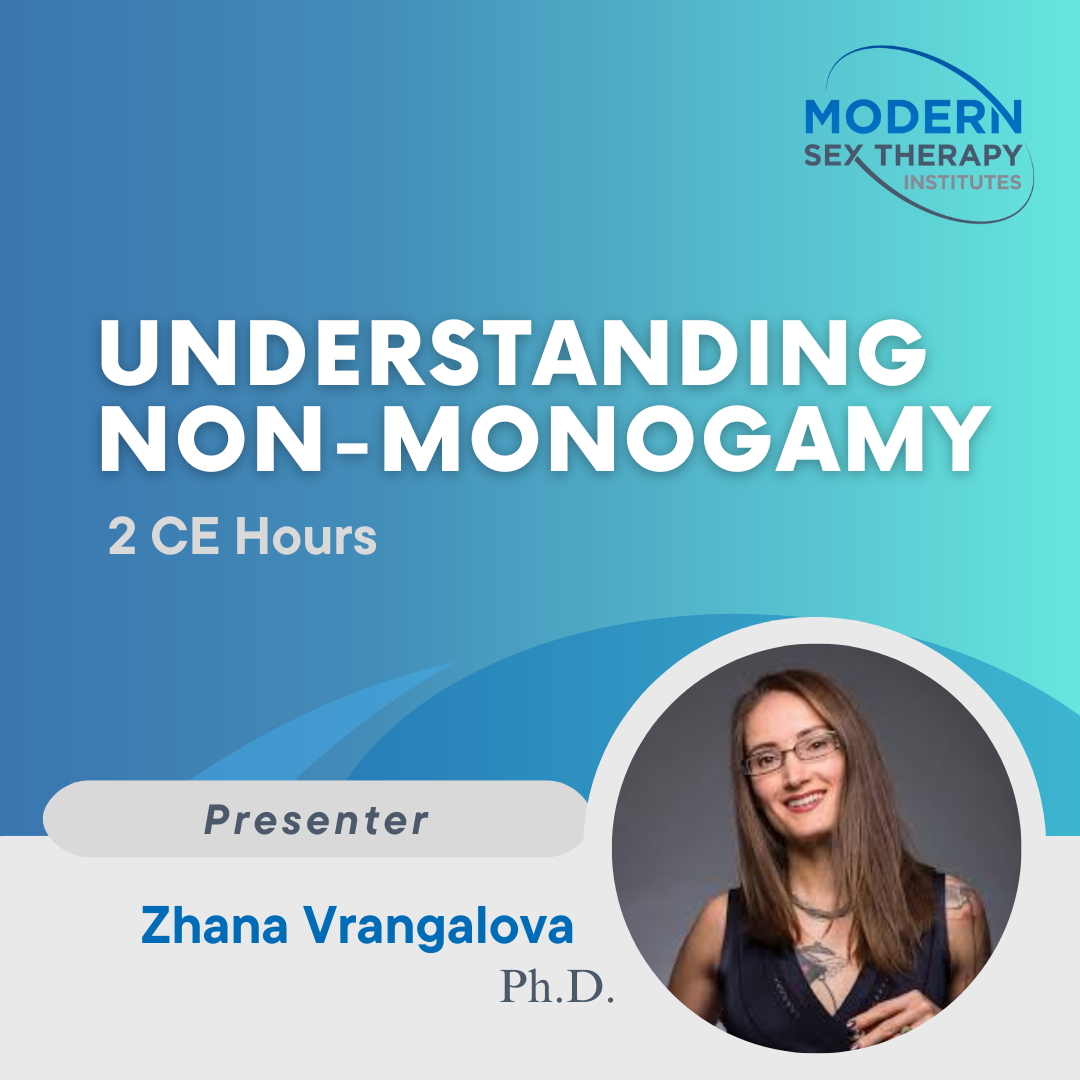
Understanding Non-Monogamy(2 CE Hours)Presenter:Zhana Vrangalova, Ph.D.
$80.00
2 CE Hours
Presented by: Zhana Vrangalova, Ph.D.
Recorded workshop available via video on demand
Description:
We live in a world that glorifies monogamy and vilifies nonmonogamy. Yet many fail to remain completely sexually and emotionally monogamous with long-term partners, with increasing number of people exploring consensually nonmonogamous relationship structures. Using recent social science research, this class will examine how much truth lies behind the beliefs that humans are a monogamous species and that monogamy is better (and consensual nonmonogamy is worse) for couples’ relationship quality, sexual satisfaction, psychological well-being, sexual health, and child rearing.
Learning Objectives:
- Describe two nontraditional, yet relatively common, sexual and relationships/ lifestyles involving consensual nonmonogamy, and list the potential risks and benefits associated with them
- Discuss myths and stereotypes from the scientifically-backed facts regarding consensual non-monogamy
- Apply evidence-based knowledge regarding nontraditional relationship structures to improve client-centered care
Activity Schedule:
Activity schedule:
– 0-15min: Intro and definitions
– 15-30 min: Are humans a (non)monogamous species?
– 30-45 min: What are people’s views about CNM?
– 45-60 min: Demographic and personality traits of CNM vs monogamous people
– 60-75 min: Relationship functioning of CNM vs monogamous people
– 75-90 min: Sexual health and functioning of CNM vs monogamous people
– 90-105 min: Raising children in CNM families
– 105-120: Questions & exercises
Speaker Bio:
Zhana Vrangalova, PhD, is a NYC-based sex researcher who studies casual sex, nonmonogamy, and sexual orientation. She holds a PhD in developmental psychology from Cornell University, and currently teaches human sexuality-related courses as an adjunct professor at New York University. Her scholarly work has been published in a number of academic journals, including the Archives of Sexual Behavior, Journal of Sex Research, Social Psychology and Personality Science, Journal of Youth and Adolescence, and Journal of Social and PersonalRelationships. She is also passionate about bringing accurate scientific information to nonacademic audiences, by writing about sexuality for popular media (for e.g., Playboy, Alternet, NY Daily News, Teen Vogue, Psychology Today), sharing new sex research on her social media (including Twitter, Instagram, Facebook), speaking to diverse groups from college students to health care practitioners, and providing private sex education consulting. Dr. Zhana runs the Casual Sex Project (a place for people to share their true hookup stories), and is currently working on a book about the science of healthy hookups.
Class originally recorded: 1/25/2018.
Social workers completing this course receive 2 cultural competence continuing education credits.