
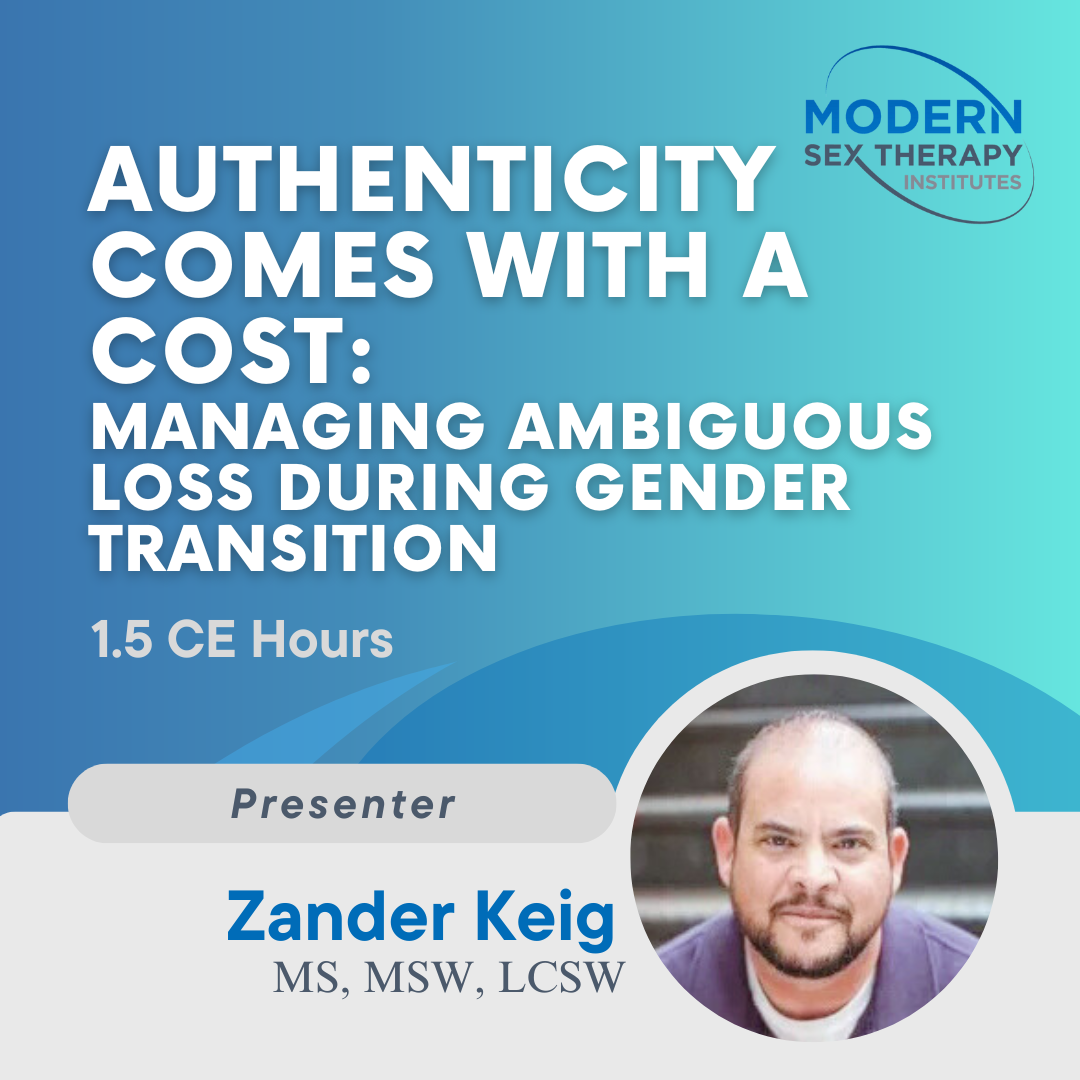
Authenticity Comes With A Cost: Managing Ambiguous Loss During Gender Transition (1.5 CE Hours, 2024)
$80.00
Presented By: Zander Keig, MS, MSW, LCSW
1.5 CE Hours
Recorded workshop available via video on demand
AASECT Category:
Human Sexuality Education, Section D.
Course Description:
An overview of the two competing social conceptual frameworks and four transition sense-making frames that contribute to our inability to concretely describe and discuss our experience of gender and contribute to the experience of ambiguous loss for those who undergo a gender transition and their loved ones.
Learning Objectives:
• Define Ambiguous Loss
• Recognize the two competing social conceptual frameworks at play
• Differentiate the four transition sense-making frames applied
• Understand the impact of ambiguous loss on a gender transition
Speaker Bio:
Zander Keig, is an award-winning social worker, educator, and speaker with many distinguishing accolades, including 2023 Caregiving.com LGBTQIA Advocate of the Year, 2020 NASW National Social Worker of the Year, 2020 Harry Benjamin Distinguished Educator of the Year, and 2018 NASW CA Social Worker of the Year. Zander has earned a BA in Interpersonal Communication (1999), an MS in Conflict Analysis and Resolution (2003), and an MSW in Clinical Social Work (2012). He has delivered conflict mitigation, social care, diversity and inclusion, and emotional well-being workshops for over 30 years. Zander hosts the Umbrella Hour podcast on the UK Health Radio Network.
Related products
-
Diagnosis & Risk Assessment of Sexual Offending Behaviors Presenter:Jeannie Brooks, Ph.D.
$320.00 -

Half day or Sunday Workshop (4 hours; 4 CE Hours)
$160.00 -
Eating Disorders, Sexual Health and FertilityPresenter:Constance Quinn, LCSW
$80.00 -
Sexual Abuse TreatmentPresenter:Blaise Amendolace, Psy.D.
$320.00