
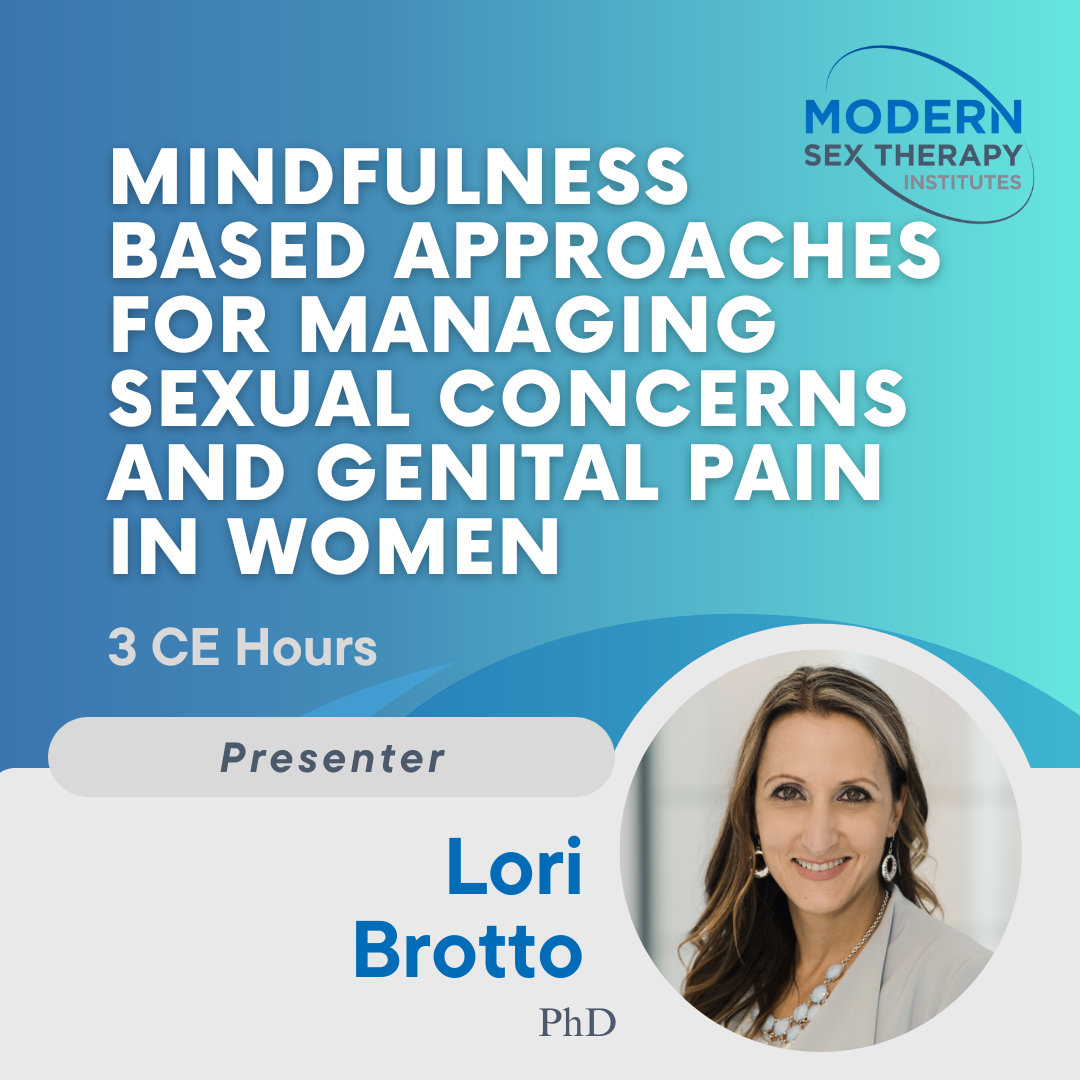
Mindfulness based approaches for managing sexual concerns and genital pain in women (3 CE Hours)
$125.00
3 CE Hours
Presented by Lori Brotto, PhD
Recorded workshop available via video on demand
AASECT Category:
Human Sexuality Education
Section M
Summary of workshop:
Sex in a multi-tasking world has become distracted, pressured, and difficult. Rates of sexual dysfunction in men and women are high, and discrepant sexual desire in couples represents one of the most common causes for seeking sex therapy. For women, there is only one FDA approved medication, Addyi, and it only marginally increases sexual desire levels above placebo. Mindfulness meditation, defined as present-moment, non-judgmental awareness, has become a prominent tool in Western healthcare for a wide range of medical and psychological ailments, from pain to anxiety to tinnitus. Over the past decade, my team and I have been applying and testing mindfulness-based interventions for women with low sexual desire, and the empirical findings strongly point to a beneficial effect of group mindfulness interventions on sexual function, mood, relationship satisfaction, and sex-related distress. In this talk, I will review the science and practice of mindfulness as it has been applied to cultivating sexual desire in women. Ample time will be spent practicing the same mindfulness exercises we use in our groups.
Objectives:
- To describe what is mindfulness-based cognitive therapy
- To review the empirical evidence for mindfulness as it has been applied to sexual dysfunction
- To discuss mechanisms underlying the purported benefits of mindfulness for women’s sexual difficulties and genital pain
- To gain experiential practice in mindfulness-based skills
- To understand the role of the 3 levels of inquiry and to practice during the workshop
- To discuss where to go from here in regards to additional training for the health care provider
Part 1, 2.5 hours
Overview of what is mindfulness
- Definition
- Evolution
- Efficacy in common populations
- Why did we apply mindfulness to sexual difficulties?
Patient recordings of why mindfulness is relevant
Practicing together and Inquiry
Part 2, 45 min
History of mindfulness as applied to sexual concerns in cancer survivors
Body Scan
Recordings of patient experiences
Why is nonjudgment especially important?
Part 3, 45 min
Mindfulness for low sexual desire
Outline of the 8 sessions MBCT for low desire
Working with difficulties practice and Inquiry
Sexual sensations recording
Pleasurable Touch
Part 4, 40 min
Mindfulness for PVD
Eliciting pain practice
Inquiry
Self-compassion exercise
Part 5, 15 min
Sensate focus
Mindfulness in relationships
Mindfulness for situational ED
Treatment manuals
Speaker Bio:
Lori A. Brotto, PhD, R Psych is the Executive Director of the Women’s Health Research Institute at BC Women’s Hospital and Health Centre. Dr. Brotto is a Professor in the Department of Obstetrics and Gynaecology, with a Joint Appointment in the Department of Psychiatry. She holds a Canada Research Chair in Women’s Sexual Health. Her program of research focuses on women’s sexual health, and includes randomized controlled trials of psychological interventions (such as mindfulness and cognitive behavioural therapy) to address low desire in women and chronic genital pain (vulvodynia). She has a strong interest in quality of life among survivors, and has been involved in a number of studies to address sexual health among cancer survivors. To that end, she is a member of the Gynecologic Cancer Collaborative Cluster, lead by Dr. Gavin Stuart. Her CFI-funded research lab is located at Vancouver Hospital and is equipped with sexual psychophysiological measures, an eye tracker, and infrastructure to support salivary hormone collections. She also collaborates on studies exploring asexuality, culture and sexuality, and most recently, digital technologies to deliver women’s sexual health programs.
Related products
-
Treatment of Sexual Offending Behaviors Presenter:Danielle Besaw, M.A.
$160.00 -
![Full Weekend [Fri-Sun] (20 hours; 20 CE Hours)](https://modernsextherapyinstitutes.com/wp-content/uploads/2023/04/Full-Weekend-Fri-Sun-20-hours-20-CEs-300x300.jpg)
Full Weekend [Fri-Sun] (20 hours; 20 CE Hours)
$800.00 -
Finding the Sex You Lost – Transforming limiting beliefsPresenter:Sylvia Rosenfeld, LCSW
$160.00 -
Diagnosis & Risk Assessment of Sexual Offending Behaviors Presenter:Jeannie Brooks, Ph.D.
$320.00