
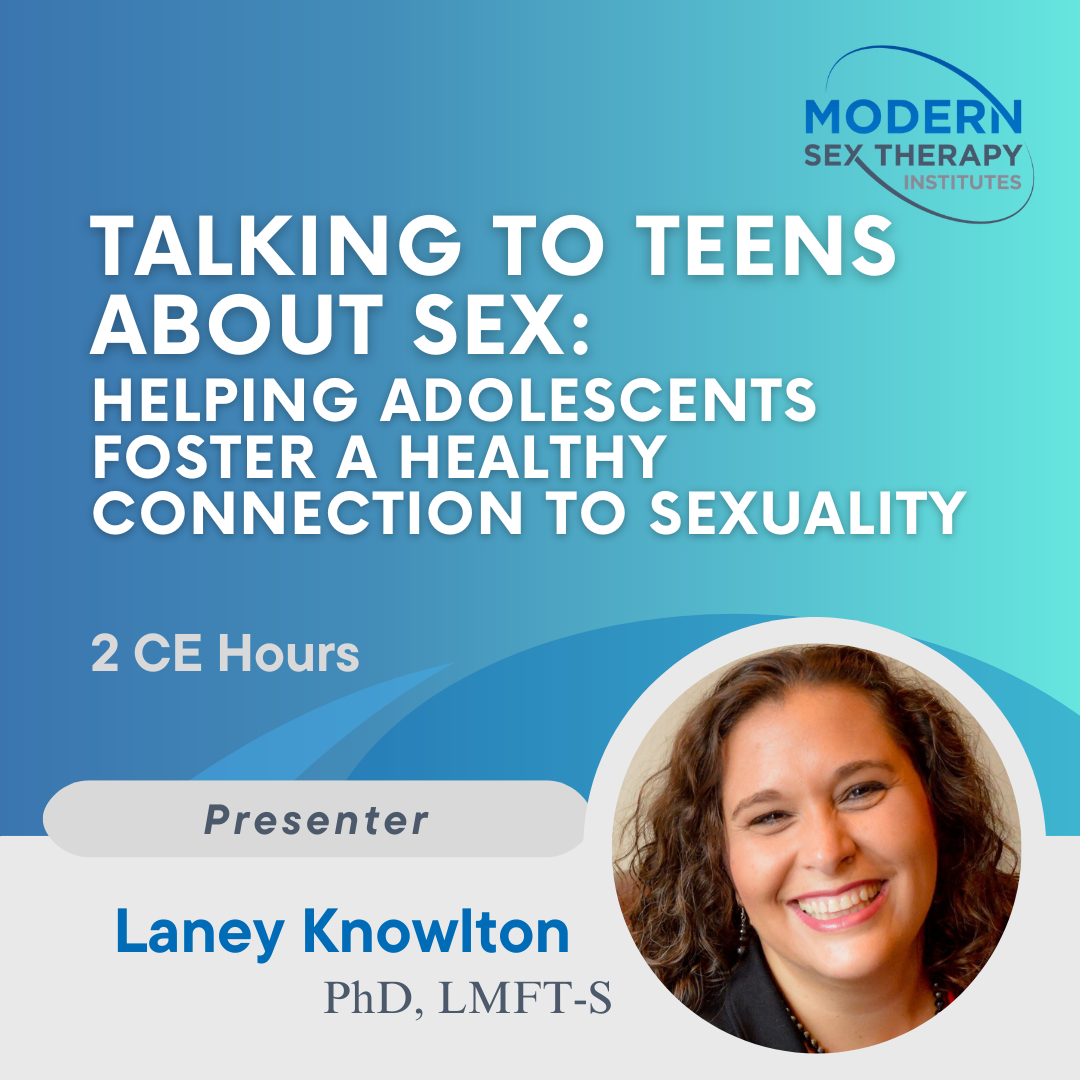
Talking to Teens About Sex: Helping Adolescents Foster a Healthy Connection to Sexuality (2 CE hours)
$80.00
Presented By: Laney Knowlton, PhD, LMFT-S
2 CE Hours
Recorded workshop available via video on demand
AASECT Category: Human Sexuality, Section B.
Description:
Adolescent sexual development is one of the most clinically significant — and most frequently avoided — topics in professional training. Despite decades of research demonstrating that comprehensive, developmentally appropriate sexuality education is linked to positive health outcomes across the lifespan (Goldfarb & Lieberman, 2021; WHO, 2026), the majority of adolescents in the United States receive sexuality education that fails to meet minimum standards of accuracy (Nelson et al., 2025), and fewer than half receive meaningful sex education from parents or caregivers (Widman et al., 2021). Into this gap comes shame, one of the most significant barriers to adolescent sexual health, help-seeking, and self-protective behavior (McElvaney et al., 2022; Scheinfeld, 2021). This two-hour doctoral-level course provides mental health professionals, medical providers, educators, and advocates with an evidence-based framework for understanding, assessing, and supporting healthy sexual development in adolescents.
Drawing on the biopsychosocial model (Nimbi et al., 2022), attachment theory (Mikulincer & Shaver, 2023; Therriault et al., 2024), the Dual Control Model of sexual response (Janssen & Bancroft, 2007; Nagoski, 2021), and frameworks for healthy adolescent sexuality development (Kågesten & van Reeuwijk, 2021; Tolman & McClelland, 2011), the course positions sexual shame as a clinical construct with identifiable developmental origins, recognizable behavioral patterns, and evidence-based treatment pathways. Participants will examine the three primary clinical patterns of shame-based sexual development — avoidance and withdrawal, hypersexualized or compulsive patterns, and identity-based shame — and will develop clinical strategies for building shame resilience, consent capacity, embodied self-awareness, and values-based sexuality. The course also addresses the clinician’s own developmental history as a variable in therapeutic effectiveness and provides a framework for coaching parents as essential partners in adolescent sexual health.
Learning Objectives:
- Describe healthy adolescent sexuality using evidence-based frameworks, including the WHO four-domain model and competency-based approaches, and articulate how healthy sexual development differs from performance-based or shame-driven sexuality.
- Identify the developmental foundations of adolescent sexuality, including the roles of attachment patterns, the Dual Control Model (SES/SIS), and arousal non-concordance in shaping adolescent sexual experience and self-concept.
- List the three primary clinical indicators of shame-based sexual development — avoidance and withdrawal, hypersexualized or compulsive patterns, and identity-based shame — using current peer-reviewed diagnostic and behavioral frameworks.
- Apply evidence-based clinical language and intervention strategies that promote shame resilience, self-consent, embodied awareness, and healthy boundary development in adolescent clients.
- Explain the elements of sexual consent and apply the concept of the Domino Effect to clinical and psychoeducational work with adolescents and parents, including practical language for teaching self-consent as a precursor to consent with others.
- Demonstrate affirming clinical practice across the spectrum of gender identity, sexual orientation, and relational orientation, including an understanding of how family rejection and clinical non-affirmation contribute to shame-based sexual development in LGBTQ+ youth.
- Design a plan that supports parents as primary sexual socialization agents by identifying common parental barriers to communication, providing evidence-based coaching strategies, and framing parent-adolescent communication as an ongoing scaffolded process rather than a single event.
- Analyze their own developmental history, shame narratives, and unexamined beliefs about sexuality as variables in therapeutic effectiveness, and identify ethical pathways for managing clinician reactivity in sessions focused on adolescent sexual health.
Activity Schedule
0:00–0:10 Welcome, Introductions & Course Framing (10 min)
0:10–0:30 Why This Matters — The Case for Talking Openly (20 min)
0:30–1:00 Developmental Context & Clinical Assessment Framework (25 min)
1:00–1:25 Clinical Strategies for Shame-Resilient Sexual Development (25 min)
1:25–1:45 Working with Parents & Developmentally Appropriate Practice (20 min)
1:45–2:00 Closing (15 min)
Speaker Bio:
Dr. Laney Knowlton (she/her), LMFT-S, CST, CSAT-S, CPTT-S, CCPS, CCRDS-S, CCBRT, RAE, holds a master’s in Marriage and Family Therapy and a PhD in Clinical Sexology from Modern Sex Therapy Institutes. Having worked in the mental health field since 2009, she specializes in Problematic Sexual Behaviors (PSB), infidelity, betrayal, and sexual abuse. She is the creator of the Connected Recovery® model — an attachment-focused framework integrating PSB treatment, betrayal recovery, relational counseling through an EFT lens, and sex therapy. Dr. Knowlton has authored multiple books, most recently Healing from Betrayal, Infidelity, and Problematic Sexual Behaviors (Routledge, 2025), and contributed to edited volumes. She is an AASECT Certified Sex Therapist and the current President of the Society for the Advancement of Sexual Health (SASH). An internationally recognized presenter and educator, she bridges clinical practice and professional development.
Class originally recorded: 5/15/2026
Social workers completing this course receive 2 clinical continuing education credits.