
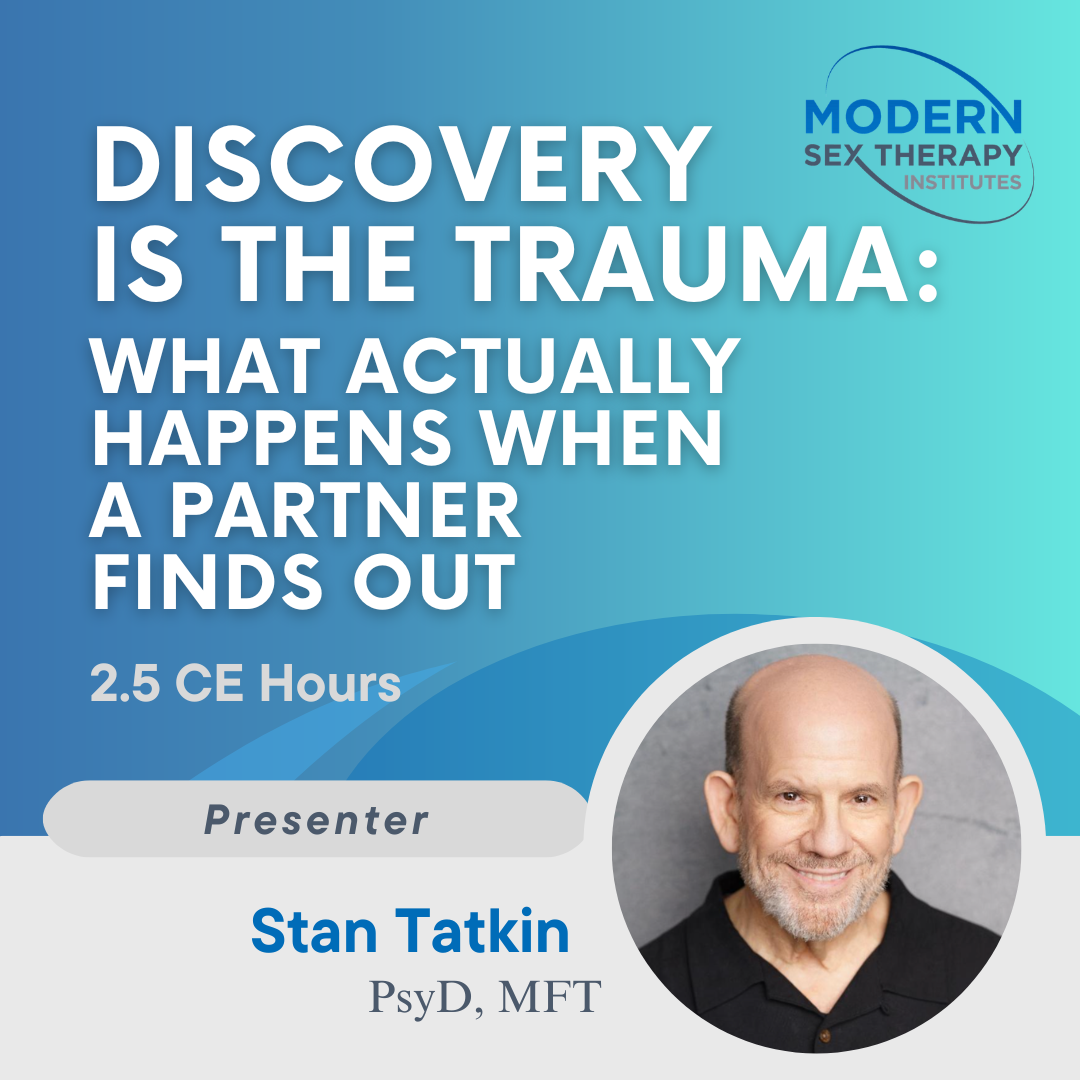
Discovery Is the Trauma: What Actually Happens When a Partner Finds Out (2.5 CE Hours)
$100.00
Presented By: Stan Tatkin, PsyD, MFT
2.5 CE Hours
Available on demand via recording
AASECT Category: Sex Therapy, Section C.
Course Description:
The most destabilizing aspect of infidelity is often not the sexual behavior itself, but the discovery of vital information that would have changed the betrayed partner’s understanding of the relationship. In that moment, trust, memory, identity, bodily safety, and erotic connection may all be disrupted at once.
This two-hour workshop examines betrayal as a psychobiological event within a two-person system. Participants will learn how discovery can produce autonomic nervous system dysregulation, hypervigilance, intrusive reconstruction of the past, loss of agency, and profound changes in sexual desire and erotic identity. The workshop will also address why some discovery partners withdraw sexually while others become more activated, controlling, performative, or compulsive.
Attention will be given to the conditions required for healing: full accountability, transparency, accurate sequencing of events, restoration of agency, and consistent behavior from the partner who created the betrayal. When the process is handled well, recovery can involve more than a return to the previous relationship. It can lead to greater relational complexity, more intentional sexuality, and a more secure and truthful partnership.
Learning Objectives:
- Explain the psychobiological impact of betrayal discovery on the discovery partner, including autonomic nervous system dysregulation, threat amplification, memory reconstruction, loss of agency, and changes in trust and perception.
- Identify the conditions required for relational and erotic recovery after betrayal, including accountability, transparency, restoration of agency, co-regulation, and the gradual reestablishment of safety necessary for desire and erotic growth.
Activity Schedule:
0:00–0:10 — Welcome, orientation, and clinical frame
Introduce the workshop’s central distinction: the most destabilizing aspect of betrayal is often the discovery of vital information that changes the discovery partner’s understanding of the relationship, the partner, and the past.
0:10–0:30 — What happens at discovery
Review the immediate psychobiological effects of discovery, including autonomic nervous system dysregulation, hypervigilance, mood instability, intrusive thinking, sleep disturbance, and loss of trust in one’s own perception.
0:30–0:50 — Memory, threat, and the “blast radius”
Explain how the discovery partner attempts to reconstruct the relationship’s history, how threat cues generalize, and why ordinary places, sounds, behaviors, and sexual situations may become associated with danger.
0:50–1:00 — Guided clinical reflection and discussion
Participants apply the framework to a brief case example and identify the discovery partner’s threat responses, loss of agency, and likely clinical needs.
1:00–1:10 — Brief break
1:10–1:30 — Betrayal and the erotic system
Examine how betrayal can alter desire, sexual safety, body image, erotic identity, arousal, and the capacity for openness or surrender. Differentiate sexual shutdown from compulsive, performative, reassurance-seeking, or controlling sexual behavior.
1:30–1:50 — Conditions for relational and erotic recovery
Outline the requirements for healing, including full accountability, transparency, restoration of agency, accurate disclosure, tolerance of the discovery partner’s symptoms, and consistent secure-functioning behavior.
1:50–2:00 — Integration, clinical takeaways, and Q&A
Summarize the treatment sequence and discuss how successful repair may lead not merely to restoration, but to greater relational complexity, intentionality, and erotic growth.
Speaker Bio:
Stan Tatkin, PsyD, MFT, is a clinician, researcher, teacher, and developer of A Psychobiological Approach to Couple Therapy® (PACT). He has a clinical practice in Calabasas, CA, and, with his wife, Dr. Tracey Tatkin, co-founded the PACT Institute for the purpose of training other mental health professionals worldwide, along with a growing PACT faculty of instructors, to use this method in their clinical practice. Together, Drs. Stan and Tracey Tatkin also lead workshops for couples.
Dr. Tatkin is a recently retired teacher and supervisor of family medicine residents at Kaiser Permanente, Woodland Hills, CA, and is an associate clinical professor at the UCLA David Geffen School of Medicine, Department of Family Medicine for more than 20 years. He is on the board of directors of Lifespan Learning Institute and served as a member of Relationships First Counsel, a nonprofit organization founded by Harville Hendrix and Helen LaKelly Hunt.
Books and CDs by Stan Tatkin, PsyD, MFT
- Wired for Love: How Understanding Your Partner’s Brain and Attachment Style Can Help You Defuse Conflict and Build a Secure Relationship, 2nd edition, New Harbinger
- In Each Other’s Care: A Guide to the Most Common Relationship Conflicts and How to Work Through Them, Sounds True Publications
- Romantic Relationships, Touring and Mental Health: The Music Industry Manual (T Embleton, editor), Chapter 8, “Romantic Relationships,” Omnibus Press
- What Every Therapist Ought to Know: Attachment, Arousal Regulation, and Clinical Techniques in Couple Therapy, Sounds True audiobook
- We Do: Saying Yes to a Relationship of Depth, True Connection, and Enduring Love, Sounds True
- Your Brain on Love: The Neurobiology of Healthy Relationships, Sounds True audiobook
- How People Change: Relationships and Neuroplasticity in Psychotherapy (M. Solomon, D. Siegel, editors), Chapter 3, “A Psychobiological Approach to Couple Therapy, W. W. Norton
- Wired for Love: How Understanding Your Partner’s Brain and Attachment Style Can Help You Defuse Conflict and Build a Secure Relationship, New Harbinger
- The Relationship Rx: Insights and Practices to Overcome Chronic Fighting and Return to Love, Sounds True audiobook
- Baby Bomb: A Relationship Survival Guide for New Parents, with coauthor Kara Hoppe, New Harbinger
- For Couples: Ten Commandments for Every Aspect of Your Relationship Journey, Chapter, Milton Erickson Foundation
- Love and War in Intimate Relationships: Connection, Disconnection, and Mutual Regulation in Couple Therapy, with coauthor Marion Solomon, W. W. Norton’s Interpersonal Neurobiology Series
Dr. Tatkin received his early training in developmental self and object relations (Masterson Institute), Gestalt, psychodrama, and family systems theory. His private practice specialized for some time in treating adolescents and adults with personality disorders. More recently, his interests turned to psycho-neurobiological theories of human relationship and applying principles of early mother-infant attachment to adult romantic relationships.
Dr. Tatkin was a primary inpatient group therapist at the John Bradshaw Center, where among other things, he taught mindfulness to patients and staff. He was trained in Vipassana meditation by Shinzen Young and was an experienced facilitator in Vipassana. He was also trained by David Reynolds in two Japanese forms of psychotherapy, Morita and Naikan. Dr. Tatkin was clinical director of Charter Hospital’s intensive outpatient drug and alcohol program and is a former president of the California Association of Marriage and Family Therapists, Ventura County chapter. He is a veteran member of Allan N. Schore’s study group. He also trained in the Adult Attachment Interview by way of Mary Main and Erik Hesse’s program through UC Berkeley.
Class originally recorded: 7/19/2026.
Social workers completing this course receive 2.5 general continuing education credits.