
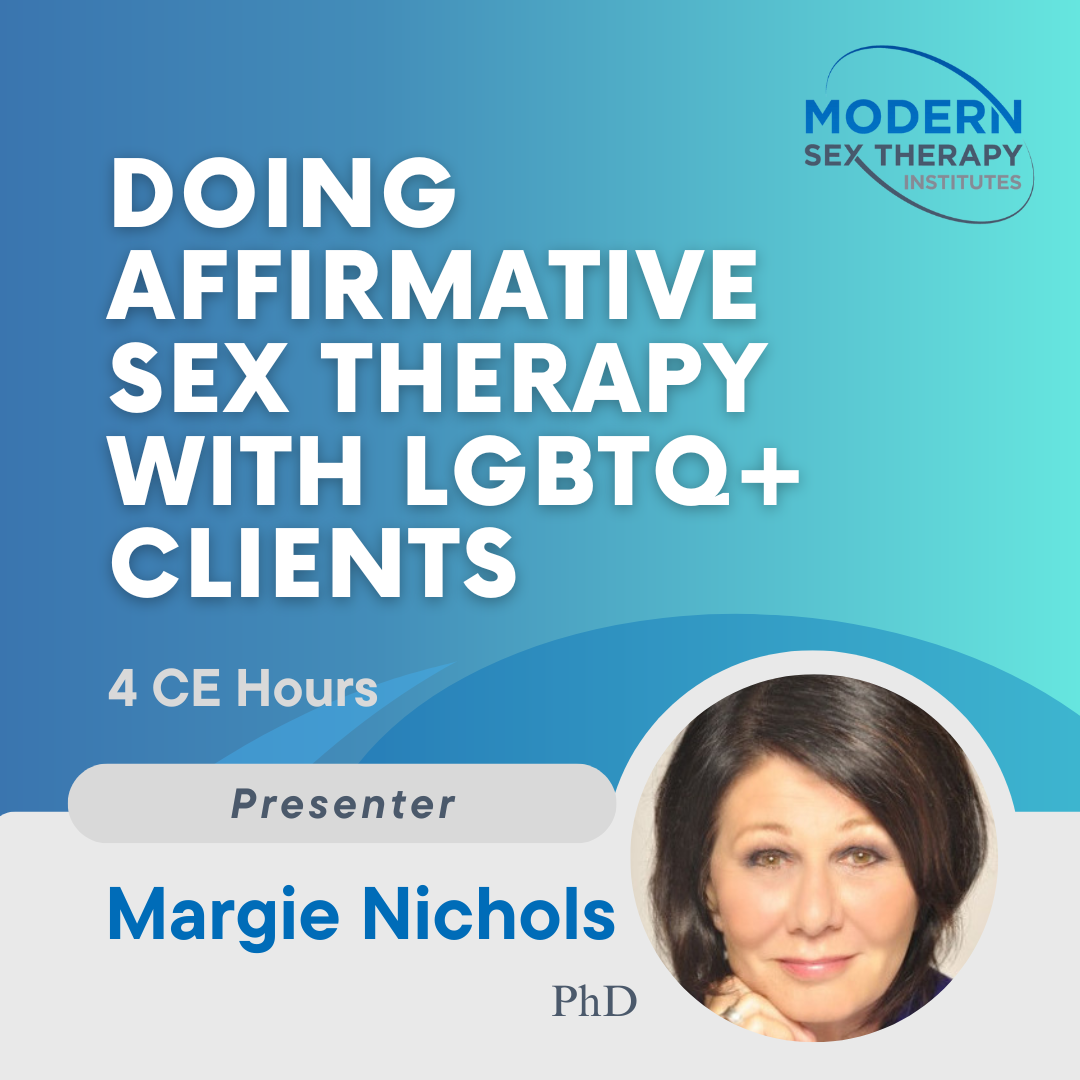
Doing Affirmative Sex Therapy with LGBTQ+ Clients (4 CE Hours)
$160.00
Presented by: Margie Nichols, Ph.D.
4 CE Hours
Recorded workshop available via video on demand
AASECT Category: Sex Therapy, Section A
It has been 53 years since homosexuality was de-classified as a mental illness and the field of ‘gay affirmative therapy’ was born. During this time, the ‘queer’ tribe has evolved from a community of gay men and lesbians to one which includes bi, pan and asexuals, transgender and gender diverse people, those whose sexual orientation is kinky, and people who practice various forms of consensual nonmonogamy. Queer affirmative therapy has correspondingly expanded to encompass the prevalent issues of all these communities, which together comprise the world of sex/gender/and relationship diverse people. Affirmative therapy developed in tandem with what until recently has been an increasing expansion of rights, e.g., in the U.S. the legalization of gay marriage.
In this comprehensive webinar, participants will be given the historical and cultural context with which to understand these changes and, importantly, to see the connection between the political/cultural climate and mental health. They will learn general principles of affirmative care that apply to all stigmatized minorities. Research on various minority communities will be presented, with the implications for treatment. Participants will specifically learn about the state of sex/gender/relationship diverse rights in the U.S today and how that has impacted minority mental health. Finally, the special clinical issues of each subgroup will be touched upon. Didactic/PowerPoint presentation will be supplemented with case examples and video. The presenter has worked as a therapist and sex therapist in queer communities for over forty years.
Learning Objectives
At the end of this webinar, participants will be able to:
- Discuss the historical and cultural context of the evolution of the queer community and concomitant development of affirmative therapy principles
- Understand the current political situation in the U.S. as it relates to queer people and the implications of current events.
- Describe issues common to all subgroups of the LGBTQ+ community such as principles of minority stress, family and community support, self-disclosure vs. ‘the closet,’ and stresses on couples and children.
- Explain current research on these communities, especially research related to mental health, relationships, and sexuality.
- Describe basic issues of transgender/nonbinary clients, intersex people, kinky clients, and those engaging in consensual nonmonogamy
Activity Schedule (15 minute segments)
Hour One
- Introductions of speaker and the topic
- Diversity in animals and throughout history
- Contemporary evolution of same sex identities; implications of paradigm change post-DSM change
- Evolution of changes/expansion of ‘queer’ community
Hour Two
- Minority stress and its connection to mental health
- Current political climate/implications for mental health
- Research on sex orientation, including same sex, asexual, sexual fluidity
- Research on intersex and gender diversity
Hour Three
- Research on BDSM and CNM
- Working with same-sex clients and couples
- Sexual fluidity/bi and pan sexuality
- Asexuality
Hour Four
- Transgender and nonbinary clients
- Intersex people
- BDSM clients
- CNM clients
Speaker Bio:
Margie is a queer-identified psychotherapist, writer, activist, and educator with forty years of experience working in the LGBT+ community. She is a licensed psychologist, AASECT certified sex therapy supervisor, and WPATH GEI (Global Education Initiative) Mentor. In 1983 Dr. Nichols founded the Institute for Personal Growth, a multi-site psychotherapy center in New Jersey that centers the LGBTQ+ community both as clients and therapists, and directed IPG until 2018. In 1985 she was a primary founder and the first Director of the Hyacinth AIDS Foundation, which continues to be New Jersey’s primary provider of social services and advocacy to people affected by HIV.
Dr. Nichols has authored more than two dozen papers or book chapters that are focused on LGBTQ+ issues. In 2020 her book, “The Modern Clinician’s Guide to Working with LGBTQ+ Clients” was published by Routledge Press.
Dr. Nichols also conducts trainings, workshops, and seminars virtually and in person. She supervises both therapists wishing to become AASECT-certified and those seeking WPATH certification, in addition to doing consults with therapists on specific cases.
She currently maintains a small private practice of therapy and consulting in Jersey City, New Jersey. She can be reached at drmargienichols@gmail.com.
Class originally recorded: 6/14/2026.
Social workers completing this course receive 4 cultural competence continuing education credits.