
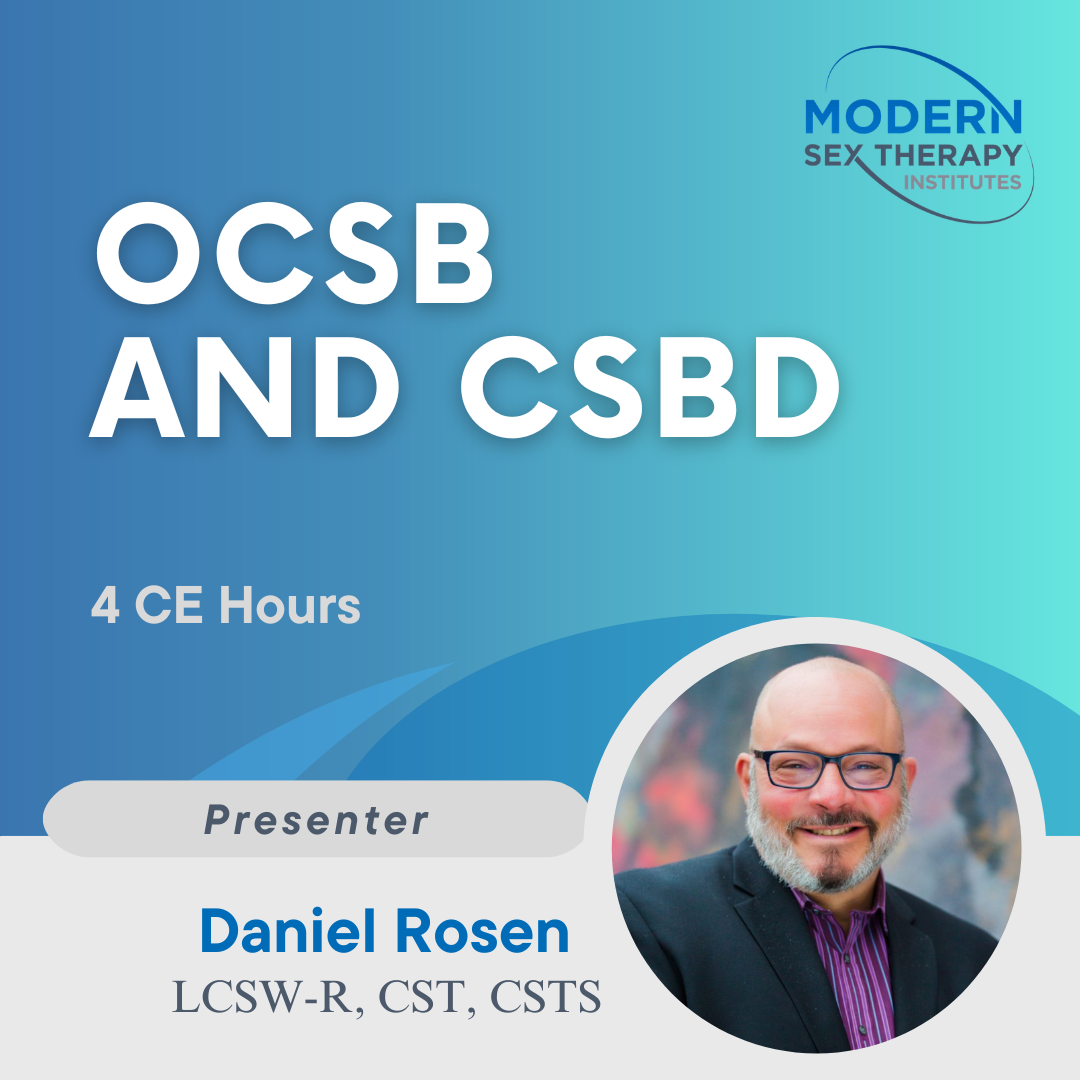
OCSB and CSBD (4 CE Hours, 2026)
$160.00
Presented By: Daniel Rosen, LCSW-R, CST, CST-S
4 CE Hours
Friday, December 11, 2026 | 2PM – 6PM EST
Live via Webinar (Zoom) or Available on demand via recording following the live event
AASECT Category: Sex Therapy, Section A.
Course Description:
This training examines contemporary alternatives to the sex addiction paradigm for understanding and treating problematic sexual behavior. The Out-of-Control Sexual Behavior (OCSB) sexual health model will be compared with the ICD-11 diagnosis of Compulsive Sexual Behavior Disorder (CSBD) and emerging international treatment guidance from the fields of sex therapy and sexual medicine.
Although OCSB and CSBD differ in important ways—most notably, OCSB is a non-diagnostic, non-pathologizing sexual health framework, while CSBD is a formal mental health diagnosis—both represent significant departures from traditional sex addiction models. Importantly, diagnosing a disorder does not necessarily require a highly pathologizing approach to treatment. Contemporary CSBD treatment guidance emphasizes careful assessment, sexual health, and the potential for integration of consensual sexual interests and behaviors into a satisfying sexual life, including when those interests are unconventional or are experienced in the context of moral conflict.
Participants will be introduced to the core concepts of the OCSB model; the diagnostic criteria for CSBD, including limitations and areas of controversy; and contemporary approaches to treatment, including guidance from the International Society for Sexual Medicine, Eli Coleman’s impulsive/compulsive sexual behavior model, and Peer Briken’s sexual medicine approach.
By the end of the presentation, participants will be able to identify how these approaches differ from the traditional sex addiction paradigm, recognize areas of overlap and divergence between OCSB and CSBD, and consider how each framework—and its limitations—can inform assessment and treatment planning.
Learning Objectives:
At the conclusion of this training, participants will be able to:
1. Discuss the core principles of the Out-of-Control Sexual Behavior (OCSB) sexual health model and describe how it conceptualizes problematic sexual behavior without relying on an addiction or diagnostic framework.
2. Describe the ICD-11 diagnostic criteria for Compulsive Sexual Behavior Disorder (CSBD) and identify important limitations and areas of controversy in applying the diagnosis.
3. Differentiate the OCSB and CSBD approaches from the traditional sex addiction paradigm and identify areas of convergence and divergence between the two contemporary approaches.
4. Apply contemporary sexual-medicine treatment guidance to clinical case conceptualization and treatment planning, including consideration of sexual health, moral conflict, and the integration of consensual sexual interests and behaviors.
Activity Schedule:
Speaker Bio:
Class originally recorded: upcoming
Social workers completing this course receive 4 clinical continuing education credits.